AI News on December 2nd
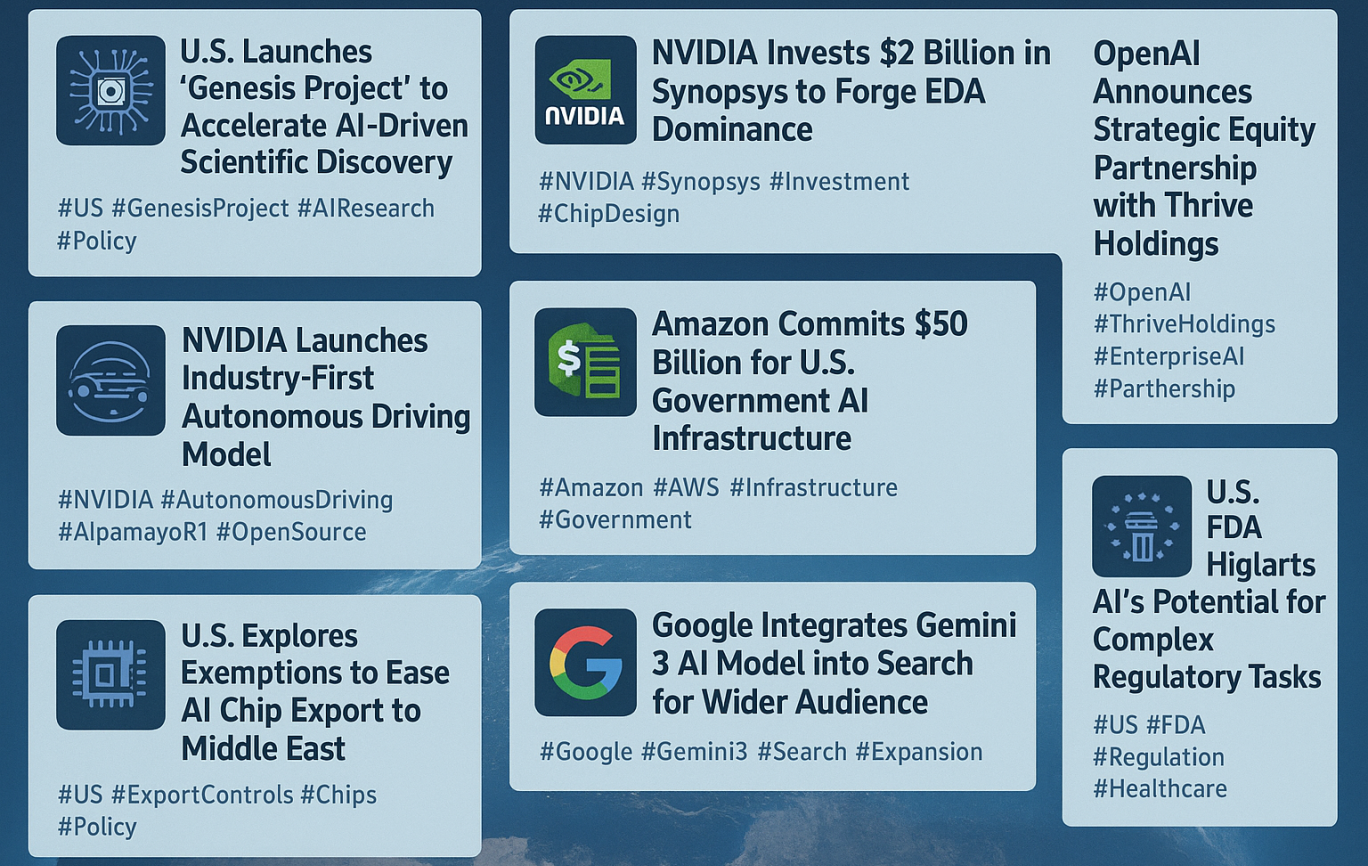
1. U.S. Launches "Genesis Project" to Accelerate AI-Driven Scientific Discovery
#US #GenesisProject #AIResearch #Policy
The U.S. has launched the "Genesis Project," a national initiative aimed at using AI to accelerate scientific breakthroughs across fields like biotechnology and quantum computing[citation:1][citation:3][citation:7]. The plan directs the Department of Energy to create an AI platform integrating supercomputers to generate scientific foundation models and support robotic labs[citation:1].
2. NVIDIA Invests $2 Billion in Synopsys to Forge EDA Dominance
#NVIDIA #Synopsys #Investment #ChipDesign
NVIDIA announced a $2 billion investment in Synopsys, the world's leading electronic design automation (EDA) company, to expand their strategic partnership[citation:2]. The collaboration aims to accelerate chip design and verification processes using NVIDIA's AI and GPU technology, which NVIDIA CEO Jensen Huang described as a "revolutionary" industry transformation[citation:2].
3. OpenAI Announces Strategic Equity Partnership with Thrive Holdings
#OpenAI #ThriveHoldings #EnterpriseAI #Partnership
OpenAI has entered a strategic partnership with private equity firm Thrive Holdings, acquiring its equity[citation:4][citation:8]. Instead of a cash investment, OpenAI will provide its models, employees, and services to Thrive's portfolio companies in IT and accounting sectors to accelerate enterprise AI adoption[citation:8].
4. NVIDIA Launches Industry-First Autonomous Driving Model
#NVIDIA #AutonomousDriving #AlpamayoR1 #OpenSource
NVIDIA released Alpamayo-R1, an open-source visual-language-action model specifically designed for autonomous driving research[citation:9]. The model enables vehicles to perceive environments and make decisions, marking a step towards Level 4 autonomy and part of NVIDIA's push into "embodied AI"[citation:9].
5. Amazon Commits $50 Billion for U.S. Government AI Infrastructure
#Amazon #AWS #Infrastructure #Government
Following the Genesis Project announcement, Amazon revealed plans to invest up to $50 billion in building dedicated AI and supercomputing infrastructure for U.S. government users[citation:1]. The project is expected to launch in 2026, adding 1.3 gigawatts of capacity[citation:1].
6. ECB's Lagarde Warns Europe Has Missed Its Chance to Be an AI Pioneer
#EU #Lagarde #ECB #Competitiveness
European Central Bank President Christine Lagarde stated that Europe has "missed the chance to be a pioneer in AI," citing fragmented regulation and high energy costs as key obstacles[citation:1][citation:3]. She warned that slow adoption of the technology could endanger the continent's future but added that decisive action could still turn the disadvantage around[citation:1].
7. U.S. Explores Exemptions to Ease AI Chip Export to Middle East
#US #ExportControls #Chips #Policy
The U.S. Congress is considering an exemption clause that would allow technology companies to ship AI chips to regions like the Middle East without obtaining an export license for each transaction[citation:1][citation:3]. This move follows approvals for advanced chip sales to Saudi Arabia, including collaborations involving NVIDIA and xAI[citation:1].
8. Google Integrates Gemini 3 AI Model into Search for Wider Audience
#Google #Gemini3 #Search #Expansion
Google has begun integrating its advanced Gemini 3 AI model into its search engine, making the feature available to users in nearly 120 countries and territories[citation:5]. The rollout supports English and targets Google's AI Pro and Ultra subscription users[citation:5].
9. U.S. FDA Highlights AI's Potential for Complex Regulatory Tasks
#US #FDA #Regulation #Healthcare
The U.S. Food and Drug Administration (FDA) stated that artificial intelligence will assist the agency in completing more complex tasks[citation:6]. The comment underscores the growing role of AI in regulatory and healthcare applications.
10. OpenAI Advocates for Government Support on AI Infrastructure Costs
#OpenAI #Policy #Infrastructure #Funding
OpenAI has urged the White House to expand tax credits under the CHIPS and Science Act to include AI data centers and power grid components[citation:1]. The company argues this would lower capital costs and unlock private investment to alleviate infrastructure bottlenecks[citation:1].